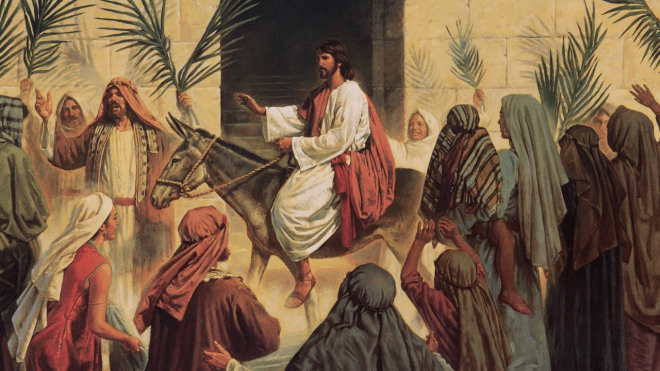
Palm Sunday has always been one of my favorite Sundays. Everything about it has something I love—palm branches waving, an excited crowd shouting praises and Jesus riding into the Holy City on a donkey. Can’t you just feel the electricity in the air? It must have been like the feeling we get waiting for a parade to start. So much anticipation and joy for what is about to happen. The celebration is what I enjoy most about this day, but I want to delve deeper into the meaning and symbolism of this special event.
Signs of Joy and Respect for Jesus
The triumphal entry into Jerusalem marks the beginning of Holy Week and it is recorded in each of the four gospels. The word, HOSANNA, was a popular refrain in 1st century Jewish culture. It means “save us” and is quoted in Psalms 118: 25-26 (see below) asking for salvation through the One who comes in the name of the Lord. The people thought that Jesus should save them from the oppression of Roman authority.
PALM BRANCHES were an ancient symbol of victory and triumph. The gospels tell us that the people cut palm branches and spread them on the road to welcome Jesus into Jerusalem. This was a sign of hope that Jesus would bring victory and independence from Rome.
The gospels also tell us that the people spread their CLOAKS on the road in front of Jesus. Laying a robe on the ground was an ancient way of showing respect and reverence for a king or very important person. Clearly, we can see that the people hailed Jesus as their King but there is one more symbol that we can’t overlook.
A Donkey?
The palm branches, cloaks and shouts of hosanna are all things that people chose to welcome their king. However, Jesus greeted the people by riding into Jerusalem on a DONKEY. Something isn’t right with this picture. If we look at the actions of the joyful crowd, we would think that Jesus should be riding a majestic horse. After all, horses were known to be associated with royalty, power and position and they were also used in war. Why would Jesus choose any other animal?
A donkey is meek, humble and a symbol of peace, quite the opposite of a regal horse. Jesus came as a humble king who would serve humankind as a suffering servant. Just as the donkey is known as the beast of burden so too, our savior carries our burden and shares our sorrows.
What the Crowd Didn’t Know
During his ministry, Jesus lived a simple life. He showed us how to live through his compassion, forgiveness and words of hope and comfort. What the Palm Sunday crowd wanted and what Jesus came to do were two different things. The Jews wanted an earthly king who would save them from the tyranny of Rome. Jesus came as a divine king who came to conquer sin and death on the cross for all mankind. Victory came when Jesus rose from the dead. Unlike the Jewish people of the first Palm Sunday, we now know what kind of King Jesus is. So, let’s wave our palm branches high this Palm Sunday and shout loud hosannas to our heavenly King. Blessed is he who comes in the name of the Lord. May he reign in our hearts forever. Amen.
If you found this post interesting, inspiring, informative, or useful, please follow us and share. Many more posts to feed your soul can be found on the Navigation Menu. God bless you.
Relevant Scripture
Lord, save us!
Lord, grant us success!
Blessed is he who comes in the name of the Lord.
From the house of the Lord we bless you. (Psalm 118:25-26)
Jesus Comes to Jerusalem as King
The next day the great crowd that had come for the festival heard that Jesus was on his way to Jerusalem. They took palm branches and went out to meet him, shouting, “Hosanna!” “Blessed is he who comes in the name of the Lord!” “Blessed is the king of Israel!”
Jesus found a young donkey and sat on it, as it is written:
“Do not be afraid, Daughter Zion;
see, your king is coming,
seated on a donkey’s colt.”
At first his disciples did not understand all this. Only after Jesus was glorified did they realize that these things had been written about him and that these things had been done to him.
Now the crowd that was with him when he called Lazarus from the tomb and raised him from the dead continued to spread the word. Many people, because they had heard that he had performed this sign, went out to meet him. So, the Pharisees said to one another, “See, this is getting us nowhere. Look how the whole world has gone after him!” (John 12:12-19)
 Spiritual Meditations