
Written by Rev. Dr. Timothy Ehrlich
Quantum Psychology is a facet of Quantum Theology; it deals with questions about human nature and how our general psychological characteristics, feelings, and behavioral traits effect how we relate to God and to each other. Quantum Psychology contains elements of the Apostle Paul’s understanding of human nature, Freudian psychology, the spiritual practices of the three great Eastern religions (Buddhism, Hinduism, and Taoism) and discoveries of quantum physics.
Jesus predicted that His followers would be capable of extraordinary supernatural/miraculous feats expanding the known boundaries of human potential (John 14:12). The experience of Christians through the centuries has proven his prediction correct. Quantum Psychology provides a scriptural and scientific explanation behind psychology and physiology that makes it possible for human beings to perform miracles. This is important information for all Christians to know because sooner or later everyone will find them self in a situation where a miracle is needed.
Quantum Psychology addresses four levels of human potential in and through a relationship with God:
- What parts of your brain are influencing why do you do the things you do?
- What is the higher consciousness the Eternal Creator of the universe wants you to take hold of?
- What are the types of things our Eternal Creator is willing to do for us?
- What are the physical, emotional, mental and spiritual conditions you need to have within yourself to be able to have your mind function on a quantum level thereby enabling you to communicate with God and to enter the interactive miraculous realm.
1. What parts of your brain are influencing the things you do?
Sigmund Freud is best known for being the creator of psychoanalysis. His theory of human psychology is that all people are motivated to action by one of three psychological structures: the Id, Ego and Superego. Our Id is comprised of our instinctual needs, impulses, and desires; our Superego is our internalized social rules and norms; and our Ego is our normal self which functions to satisfy its needs and wants and the basic needs and impulses of the Id with guidance from the Superego.
This concept is often portrayed in the popular image of a person with a little devil on one shoulder and an angel on the other shoulder. In this illustration the Id is represented as the devil on one shoulder, the Superego as the angel on the other shoulder and the Ego is the person in the middle.

Freud, who died in 1939, didn’t have the benefit of the discoveries of the physiological differences between the left and right hemispheres of the brain which were identified through split-brain experiments in the 1960s and 70s. We now know that a majority of what Freud identified as unconscious or subconscious behaviors originate in the right hemisphere and they are not unconscious; they appear to be unconscious or subconscious because they are expressed non-verbally from the right hemisphere of the brain which is non-verbal.
Freud rightly understood that the impulses of our Id are oriented to immediate gratification and driven to gain pleasure and avoid pain. The impulses of the Id are present from birth, and their impulses are essential to the survival of the human race.
The control of these impulses by the Ego, located in the left brain is essential to enable human society to function because if the impulses of the Id were not guided and controlled by the rational, logical, verbal left hemisphere of the brain, the result would be violence and other dysfunction.
The Superego is a code of values and ethics that resides in your memory but has a spiritual element as it is represented as the holy influence residing in the heart. Interestingly, the Superego is not essential for a person to function in society – sociopaths devoid of morals can function without their input based purely on logic and understanding risk, reward and threat of punishment.
The two halves of our brains are strongly connected by the corpus callosum and they can interact instantaneously back and forth throughout the day. However, our consciousness center shifts back and forth between hemispheres at a much slower rate – every one to four hours due to the ultradian rhythm in our brain waves. One hemisphere is dominant at a time in the sense that the consciousness center is primarily lodged in one side or the other at a time.
Generally, without realizing it, we try to focus our attention through that hemisphere most suited for the task at hand: when we are having a written test we are trying to use our left brain; when we are playing a musical instrument we are concentrating our consciousness in our right hemisphere. Even through one hemisphere is dominant in consciousness the connections between hemispheres allows both halves of the brain to work congruently – writing when right hemisphere dominant, and playing an instrument when left hemisphere dominant, we just don’t do those respective tasks as well as we would have if our consciousness center is focused in the hemisphere which is not the repository of the talent at hand.
Paul’s Interpretation of Freud
These same three elements of Id, Ego, and Superego are represented in Paul’s understanding of human behavior but with different names: the Id is represented as our sinful nature:
“The sinful nature wants to do evil, which is just the opposite of what the Spirit wants. And the Spirit gives us desires that are the opposite of what the sinful nature desires. These two forces are constantly fighting each other, so you are not free to carry out your good intentions. But when the Spirit directs you, you are not under obligation to the law of Moses. When you follow the desires of your sinful nature, the results are very clear: sexual immorality, impurity, lustful pleasures, idolatry, sorcery, hostility, quarreling, jealousy, outbursts of anger, selfish ambition, dissension, division, envy, drunkenness, wild parties, and other sins like these. Let me tell you again, as I have before, that anyone living that sort of life will not inherit the Kingdom of God. But the Holy Spirit produces this kind of fruit in our lives: love, joy, peace, patience, kindness, goodness, faithfulness, gentleness, and self-control. There is no law against these things!” Galatians 5:17-23 NLT
I do not understand what I do. For what I want to do I do not do, but what I hate I do. Romans 7:15 (NIV) But if I do what I don’t want to do, I am not really the one doing wrong; it is sin living in me that does it. Romans 7:20 (NLT)
The Ego is represented as minds that are infant-like in that they can easily be controlled by carnal influences of the flesh, i.e., the Id.
You are still worldly. For since there are jealousy and quarreling among you, are you not worldly? Are you not acting like mere humans? For when one says, “I follow Paul,” and another, “I follow Apollos,” are you not mere human beings? 1 Corinthians 3:3-4 (NIV)
The Superego is represented in Paul as “truths from God’s Spirit” which can give a person the mind of Christ (1 Corinthians 2:14-16).
But people who aren’t spiritual can’t receive these truths from God’s Spirit. It all sounds foolish to them and they can’t understand it, for only those who are spiritual can understand what the Spirit means. (NLT) 15 But he who is spiritual judges all things, yet he himself is rightly judged by no one. 16 For “who has known the mind of the LORD that he may instruct Him?” But we have the mind of Christ. (NKJV)
The concept of the Id, Ego and Superego also help account for sin. To Paul when the human sinful nature (Id) is given control of our actions the result is sinful actions. In his Letter to the Romans, he describes how easily the Ego (mind) and Superego (leading of the spirit) are overcome by the id:
18 And I know that nothing good lives in me, that is, in my sinful nature. I want to do what is right, but I can’t…22 I love God’s law with all my heart. 23 But there is another power within me that is at war with my mind. This power makes me a slave to the sin that is still within me… So, you see how it is: In my mind I really want to obey God’s law, but because of my sinful nature I am a slave to sin. (Romans 7:18, 22-23, 25 NLT)
So, the Id (sinful nature) overpowers the mind (Ego) and ignores the influence of the “want to do right” conscience (Superego). I don’t believe that any Christian who sincerely tries to obey Christ hasn’t experienced exactly what Paul wrote, “I want to do what is right, but I can’t.” The drives and desires of the Id are extremely powerful; they make fools of presidents and pastors alike.
2. What is the higher consciousness the Eternal Creator of the universe wants you to take hold of?
The difference between Paul and Freud is that for Paul the Superego is more than a set of values and ideals we learn from our parents and at school that becomes our internalized morality. For Paul it is a state of mind Christians are called to be in. We could also accurately describe Paul’s understanding as our consciousness center dwelling at a higher level of consciousness, one that God wants us to attain. To Paul this higher level of consciousness produces a mature spiritual Christian influenced intellectually by the teaching of Christ and spiritually by the indwelling of the Holy Spirit, resulting in the perfect control over both the sinful nature and immature Ego.
Ephesians 4:11-13 (NKJV) And He Himself gave some to be apostles, some prophets, some evangelists, and some pastors and teachers,
12 for the equipping of the saints for the work of ministry, for the edifying of the body of Christ, 13 till we all come to the unity of the faith and of the knowledge of the Son of God, to a perfect man, to the measure of the stature of the fullness of Christ.
1 Corinthians 2:16 (NLT) For, “Who can know the LORD’s thoughts? Who knows enough to teach him?” But we understand these things, for we have the mind of Christ.
Dear brothers and sisters, when I was with you I couldn’t talk to you as I would to spiritual people. I had to talk as though you belonged to this world or as though you were infants in the Christian life. I had to feed you with milk, not with solid food, because you weren’t ready for anything stronger. And you still aren’t ready, for you are still controlled by your sinful nature. You are jealous of one another and quarrel with each other. Doesn’t that prove you are controlled by your sinful nature? Aren’t you living like people of the world? 1 Corinthians 3:1-3 (NLT)
For Paul, the Christian goal is to attain true spiritual growth to the full measure of the stature of the fullness of Christ, and even to attain the mind of Christ! As Christians we should undertake this challenge he gives to us. (Cor. 4:16) Romans 15:19
3. What is God (the higher power) willing to do for you and with you for others?
Jesus gave a profound prophesy.
John 14:12 NLT, “I tell you the truth, anyone who believes in me will do the same works I have done, and even greater works, because I am going to be with the Father.”
The works Jesus is referring to are miracles; He is saying that His followers will be able to perform miracles like His own. In the Acts of the Apostles, we find several examples of this prophesy coming true:
Acts 2:43 A deep sense of awe came over them all, and the apostles performed many miraculous signs and wonders.
Acts 5:12, 16 The apostles were performing many miraculous signs and wonders among the people. And all the believers were meeting regularly at the Temple in the area known as Solomon’s Colonnade… Crowds came from the villages around Jerusalem, bringing their sick and those possessed by evil spirits, and they were all healed.
Acts 14:3 But the apostles stayed there a long time, preaching boldly about the grace of the Lord. And the Lord proved their message was true by giving them power to do miraculous signs and wonders.
The Apostle Paul spoke several times about his own ability to perform miracles, and in his letter to the Romans he indicated that performing miracles was part of his evangelism approach:
Romans 15:19 They were convinced by the power of miraculous signs and wonders and by the power of God’s Spirit. In this way, I have fully presented the Good News of Christ from Jerusalem all the way to Illyricum.
There is no indication in the Bible that the ability to perform miracles was intended only for the time of the apostles; in addition to Jesus’ prophesy, we also have these passages from the Apostle Paul.
1 Corinthians 6:19 Don’t you realize that your body is the temple of the Holy Spirit, who lives in you and was given to you by God? You do not belong to yourself,
1 Corinthians 12:7,10-11 A spiritual gift is given to each of us so we can help each other… 10 He gives one person the power to perform miracles, and another the ability to prophesy. He gives someone else the ability to discern whether a message is from the Spirit of God or from another spirit. Still another person is given the ability to speak in unknown languages, while another is given the ability to interpret what is being said. 11 It is the one and only Spirit who distributes all these gifts. He alone decides which gift each person should have.
Paul said that the Spirit gives a (miraculous) spiritual gift to each believer, there is absolutely no indication anywhere in scripture that it was a temporary condition. I have taken the survey in many churches that I have preached at over the years asking: “If you have ever seen or experienced a miracle would you raise a hand?” Invariably, regardless of the size of the congregation, several hands are raised.
4. What are the physical, emotional, mental, and spiritual conditions you need to have within yourself to be able to have your mind function on a quantum level enabling you to communicate with God, and enter the interactive miraculous realm?
Successful prayers, that is, prayers which are heard and answered with a miraculous result, arise from the Superego; that is to say from the heart. The heart is a mysterious entity, but it is also the spiritual center of the person; it is the location through which communication with God occurs.
Proverbs 4:23 (NLT) “Guard your heart above all else, for it determines the course of your life.”
Matthew 5:8 (ESV) “Blessed are the pure in heart, for they shall see God.”
Mark 11:23-24 (ESV) Truly, I say to you, whoever says to this mountain, ‘Be taken up and thrown into the sea,’ and does not doubt in his heart, but believes that what he says will come to pass, it will be done for him. Therefore, I tell you, whatever you ask in prayer, believe that you have received it, and it will be yours.
Romans 10:10 (NLT) For it is by believing in your heart that you are made right with God, and it is by confessing with your mouth that you are saved.
It can be extremely difficult to get into and stay in the Superego / heart consciousness level for any length of time especially if you have not done so before.
Prayer requests fall into two categories: ordinary and emergency. In ordinary times to truly connect with God in prayer there are ten potential stumbling blocks that can prevent us from getting into Superego communication with God. Faith is important but that is not all that is required; we can be hindered by our emotions, mental attitude and spiritual readiness. In a time of crisis, it is much easier to mentally climb into our heart and stay there, whereas in ordinary times we may subconsciously cling one or more of these stumbling blocks. A true crisis opens us up to God almost instantaneously because at that moment our heart is ready to break, in that state we become completely humble; we recognize our powerlessness; we become appropriately contrite because we recognize our neglect of our relationship with God; and we are willing to surrender all to God.
In ordinary times these are the potential stumbling blocks that can take hours of focused prayer to get past.
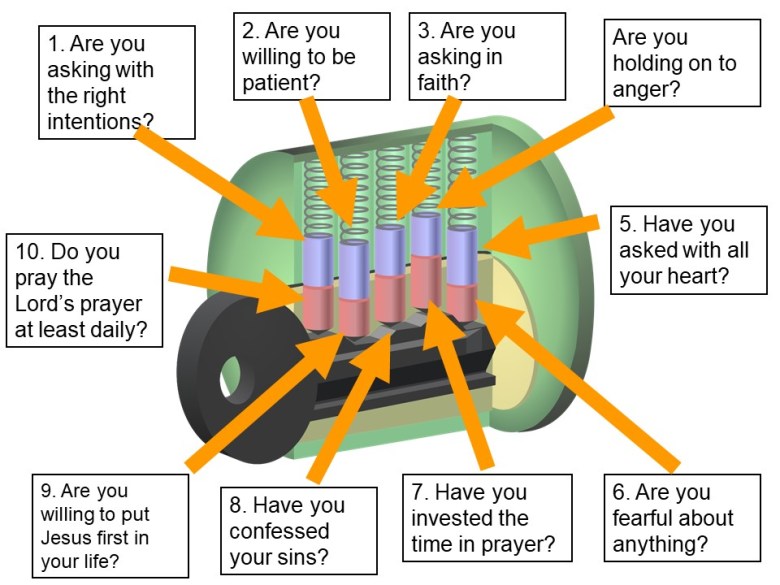
1. Jesus said when we pray, we should pray in solitude if possible (Matthew 6:6-7). 2. The obstacle of failure to obey Christ’ commandments (Matthew 7:26).
3. Asking with the wrong intention is a non-starter (James4:3-6).
4. Whatever we ask of God must be within God’s will to grant. The general rule to remember is God is not a labor-saving device: God will not do for us what we can do for ourselves.
5. Faith in the reality of God; faith that God is listening; faith that God can do what we ask (Mark 11:23-24).
6. We must be humble before God, willing to accept what God’s answer is even if it is a “no” (Luke 22:42).
7. Trusting in God is essential (John 14:1).
8. Anger is a stumbling block to answered prayer (Matthew 5:23-24, Ephesians 4:26-27)
9. It is better to say one short sincere prayer from the heart than 100 mindless repetitions of the hail Mary (Matthew 6:7)
10. If you are asking for something that you know in your heart is not right it will not happen (Psalm 139:1).
Paul told us that our goal as Christians is to follow the leading of the Spirit, (i.e. functioning in the superego) and “let God transform you into a new person by changing the way you think…” (Romans 12:2 NLT). He described a process where first we hear, then we learn, then we do the work of getting rid of sin (gaining control of our Id) by letting the Spirit transform our thoughts to holy thoughts, which corresponds to giving control of our thoughts and behavior to the guidance of our Superego.
Since you have heard about Jesus and have learned the truth that comes from him, throw off your old sinful nature and your former way of life, which is corrupted by lust and deception. Instead, let the Spirit renew your thoughts and attitudes. Put on your new nature, created to be like God—truly righteous and holy. Ephesians 4:21-24 (NLT)
The Id, Ego, & Superego in Maslow
The Id, Ego, & Superego representing the three basic facets of human psychology, correspond nicely to the Hierarchy of Needs identified by the brilliant psychologist Abraham Maslow. Maslow identified three primary categories of animating motivations which all people experience.
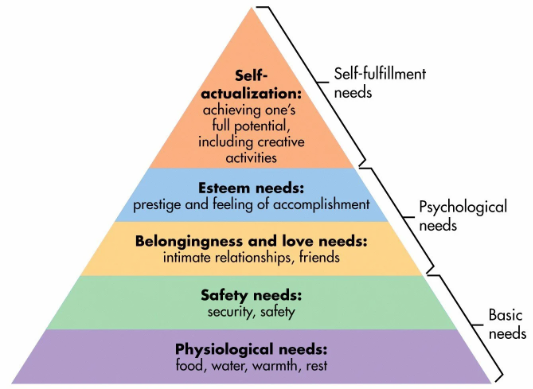
Our basic needs, as Maslow described them, correspond to the needs and desires of our Id. Our psychological needs are obviously functions of the Ego, and our self-actualization needs are the things our Superego motivates us to do.
The Bible makes it clear that God wants us to enjoy life. The joys that God is telling us to enjoy are reaching out to us in all three elements of our psychology and each of the needs identified by Maslow.
In Psalm 118:24 we read that we should rejoice in each day. Ecclesiastes is famous for its emphasis on the importance of us enjoying life.
When people live to be very old, let them rejoice in every day of life…Young people, it’s wonderful to be young! Enjoy every minute of it. Do everything you want to do; take it all in. But remember that you must give an account to God for everything you do. Ecclesiastes 11:8-9 (NLT)
In Nehemiah 8:10 (NLT) we read:
“Go and celebrate with a feast of rich foods and sweet drinks, and share gifts of food with people who have nothing prepared. . . Don’t be dejected and sad, for the joy of the LORD is your strength!”
The Apostle Paul wrote in Philippians 21:21,
“Rejoice in the Lord always; again I will say, rejoice.”
Jesus said (John 10:10) the reason he came to earth is so that we
“may have life and have it more abundantly.”
The word “abundantly” is from the Greek perissos which is also translated in to English as beyond measure, and exceedingly abundantly above.
Jesus also said:
“I have told you these things so that you will be filled with my joy. Yes, your joy will overflow!” (John 15:11 NLT).
Where does sin fit into the picture?
In Quantum Psychology we recognize that the behaviors Paul recognized as sins are instinctive innate Id drives, not controlled by or overpowering the guidance of the Ego, and the solution preventing these sins is to have a strong and prepared Ego assisted by the morals and values of the Superego.
If you are an adult human being, you have no doubt realized through experience that the part of the mind that contains your sexual, survival and hunger drives is primitive and instinctual, and potentially can lead you into activities which are harmful to your or another person’s health and wellbeing. Therefore, you need to keep your Id activities in the healthy and socially acceptable range.
Obviously, the drives of the Id we all have are essential for the protection, maintenance and reproduction of the human race. However, because the actions arising from our Id are innate and instinctive in nature and are processed through the non-verbal right half of our brain, it is easy for the feelings of our Id to overcome the best judgment of the Ego if it has not prepared a sufficient response to that temptation in advance.
Over eating is a perfect example: we eat something that tastes good to us and most people, certainly including me, continue to eat what tastes great long past the point of ending our hunger. We eat till we are stuffed, and often we then look around for dessert, all the while knowing intellectually that we should stop; hence the description of a food item as sinfully delicious.
So, every sin starts out as a normal, natural, healthy impulse or desire in our Id that we allow to grow into an extreme or to an extent that is unjustifiably damaging the health, wellbeing or property of ourselves or others. Take for example the Seven Deadly Sins:
lust starts out as a normal, natural, healthy impulse or desire for sex, but it is such a strong impulse that it leads even presidents and preachers to make fools of themselves; people consumed with lust do things that are damaging to themselves and others.
Hunger is a normal, natural, healthy daily experience but without controlling our appetite it becomes the sin of gluttony and unhealthiness occurs.
Anger is a normal, natural, healthy response; it can fire up our fight or flight response and save our life, but wrath is anger given absolute freedom and it can lead us to unjustifiably injuring or taking the life of another.
It is natural and normal to want good things, but unchecked it becomes greed, and though it arises in the Id it crosses over into the Ego as we use our intellect to scheme and fanaticize and make plans.
When we find ourselves struggling with sin, as Paul did, it helps us greatly to recognize that our temptation to sin is coming from the part of our Id-based human nature that is seeking to gain control and cause us to act in ways we know are sinful. This is where the Superego of the believer starts to experience the supernatural help and influence of God: the Holy Spirit is a manifestation of the presence of God, and both Paul and Jesus tell us that we can have the Spirit of God inside us to guide us and empower us. Paul tells us that the Spirit Christ Jesus makes us free from the law of sin and death (Romans 8:2), but as we consider what Paul also wrote in Romans 7:15-20 about his own sinning, we must understand that our freedom from sin and death is not from leading a perfect sin- free life but rather through forgiveness and the self-offering of Christ on the cross.
How should we think about ourselves psychologically?
To get a complete picture of how we should think of ourselves psychologically we need to look at several different Bible passages, but in general, we are expected to maintain the same kind of duality Jesus had as the son of God who washes the feet of his disciples. We are called to recognize the extraordinary nature of our humanity: we are children of God, the resting place of the Holy Spirit, capable of performing miracles; yet we must also recognize that we are all sinners called to be servants of others.
Psalm 139 you knit me together in my mother’s womb, and I am fearfully and wonderfully made. (139:13-14 NIV)
John 1:12 (NLT) But to all who believed him and accepted him, he gave the right to become children of God.
Romans 3:23 For everyone has sinned; we all fall short of God’s glorious standard.
1 Corinthians 6:19 “realize that your body is the temple of the Holy Spirit, who lives in you and was given to you by God.”
John 13:14-15 And since I, your Lord and Teacher, have washed your feet, you ought to wash each other’s feet. 15 I have given you an example to follow. Do as I have done to you.
Luke 17:10 In the same way, when you obey me, you should say, ‘We are unworthy servants who have simply done our duty.’
So, we have both the tremendous ego boost of being a supernaturally aided child of God with the tremendous humbling reminder that we are to be servants of others. From all the Biblical citations above we may also infer or draw several relevant conclusions:
- That God created each of us fearfully and wonderfully with miraculous capacities.
- That God wants us to enjoy our life.
- That to be alive is a precious gift from God, and therefore:
- As a rule, any activity(s) we engage in which damages the health and wellbeing of one’s self or others is a rejection of the will of God and therefore a sin. The exception to the rule is self-sacrifice, which can be fatal but still a virtuous act.
- The practice of our religion should celebrate the gift of life as the supreme gift through which we enjoy all the other gifts in life.
- We should emphasize health and joyful appreciation of life through the indwelling of the Holy Spirit, which all increase to the extent that we follow the teachings of Jesus.
What can we take from Eastern religions’ understanding of human psychology?
Buddhism and Hinduism have very similar views of human nature to the view of human nature in Christianity and in quantum psychology. Buddhism and Hinduism both believe that human beings have a dynamic innate capacity for mystical abilities including pure consciousness, intuition, inner vision, knowledge, the detection of evil, and spiritual communication and spiritual awareness and enlightenment.
The “higher state” is summarized as reaching enlightenment and most of its qualities are the same as the gifts distributed by the Holy Spirit, and as those of a person living in Christ Consciousness or their superego. This capacity is represented in Buddhism and Hinduism as the third eye as commonly portrayed on the foreheads of the Hindu God Shiva and Buddha. This capacity is our true, essential self but our potential is clouded by factors that sound just like those of our Id: ignorance, negative emotions, greed, hatred, and delusion.
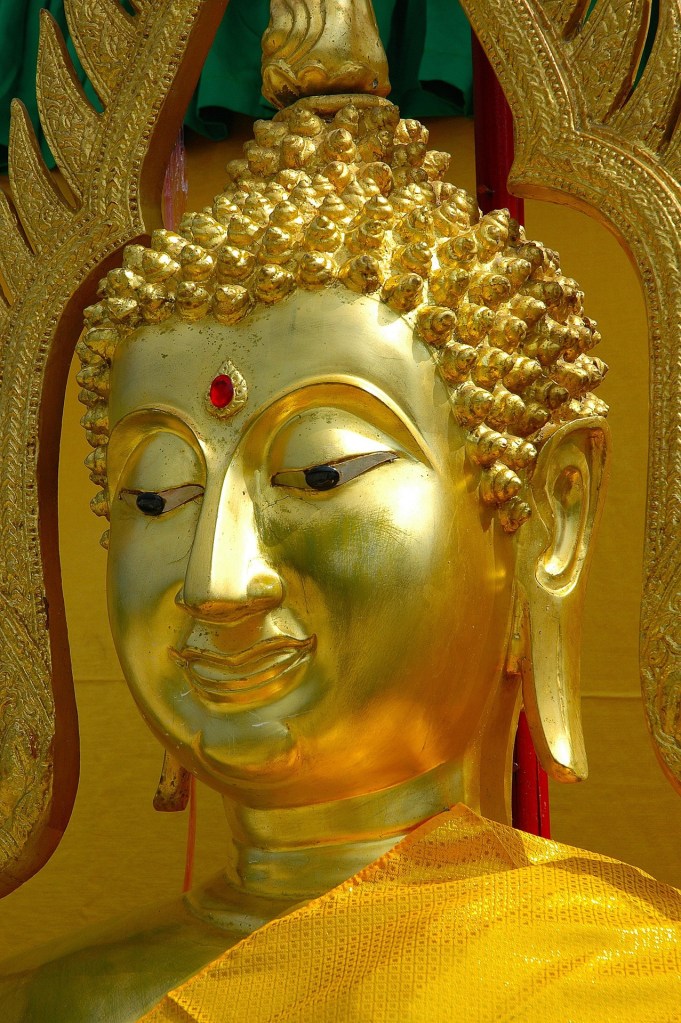

The ego is represented as the self-carrying out its activities and satisfying its desires and ambitions while trying to access the powers and abilities of the third eye through ethical actions, purifying the mind and proper understanding and effort.
The primary difference between Christianity, Buddhism and Hinduism is that while we all share the ultimate goal of overcoming ignorance and reaching our highest potential through righteous living, ethical duty, and spiritual realization, in Christianity we receive gifts from the Holy Spirit which, through our faith, helps us receive God’s grace which covers our shortfalls through the self-sacrifice of Christ.
In Buddhism and Hinduism there is no supernatural help, each individual lives through many reincarnations hopefully making progress each time until finally one’s true divine nature emerges, and one escapes the endless cycle of reincarnation.
What does quantum physics contribute to the understanding of human nature?
Quantum Psychology is interested in the quantum nature of consciousness – what is the physiology of the molecular and atomic structures that enable consciousness. Current research is centered around understanding how consciousness functions, what explains the very real, near death, out-of-body experiences, which indicate that consciousness can survive death, and thus indicating the existence of the soul.
The human brain is incomprehensibly complex; the average brain has 86 billion neurons that form 100 trillion connections to each other. The brain generates an estimated 1 quadrillion (10,000,000,000,000,000) electrical impulses per day! An average brain generates approximately 0.0850 watts of electrical power, enough to power 1000 smart watches.
There is currently no definitive understanding of how consciousness occurs in our brains. It is known that the neurons, which are responsible for thought and the transmission of brainwaves are made up of microtubules of proteins. It is believed by some researchers that the atoms within the microtubules are in a quantum state known as super position (when the atom is in two states simultaneously until acted on by conditions in its environment and then chooses one state or the other); a thought may be the near simultaneous choice of atoms in millions of microtubules. The super position of atoms in the microtubules seems to be the best explanation for how anesthetics cause unconsciousness – on a quantum level the molecular structure of anesthetics interferes with and disrupts the superposition of the atoms within the microtubules.
Basically, at a subatomic level it seems that our brains function at a quantum level. Some researchers suggest that quantum entanglement (when atoms are linked together so that what happens to one happens to the other simultaneously even across great distances) is at play in the simultaneous firing of networks of neurons in a thought or brainwave. If true, this would indicate that our brains are subject to large-scale levels of quantum entanglement; this becomes important as research in quantum physics indicates that the entire universe is probably linked on the quantum level!
Data from over 10,000 near death experiences has demonstrated that consciousness can escape the body and continue outside the body, able to see and hear. The out-of-body experience does not occur 100% of the time or to everyone who is technically dead for a time and then revived, but it does happen to thousands of people – enough to prove that it is a scientifically validated phenomenon.
Article on Near Death Experiences
How Quantum Physics Explains Eternal Life
There is no technical term for the out of body experience but the fact that it does occur raises two intriguing observations:
1. Near death experiences indicate that the consciousness which escapes the body is the soul since many such experiences include a visit to heaven and/or interactions with loved ones who have died in the past.
2. Since it appears the entire universe is linked on the quantum level, and since consciousness apparently exists in a quantum state in relationship with, but independent of, the physical structure of the brain, then quantum entanglement would explain or provide the physiological explanation for the phenomenon experienced by millions of Christians wherein prayer is instantly answered by the God who is in and through the infinite universe.
Quantum entanglement would also explain or provide the physiological explanation for the apostle Paul’s statements that our soul is connected to God:
Romans 8:16 For his Spirit joins with our spirit to affirm that we are God’s children.
1 Corinthians 6:17 But the person who is joined to the Lord is one spirit with him.
Ephesians 2:18 Now all of us can come to the Father through the same Holy Spirit because of what Christ has done for us.
Ephesians 4:4-6 For there is one body and one Spirit, just as you have been called to one glorious hope for the future. 5 There is one Lord, one faith, one baptism, 6 and one God and Father, who is over all and in all and living through all.
Our connection to the Holy Spirit is also what empowers spiritual gifts, including the ability to perform miracles.
 Spiritual Meditations