He may have had his doubts about Jesus’ resurrection, as did the other 11, but St. Thomas, evangelist to India, had great redeeming qualities.

He may have had his doubts about Jesus’ resurrection, as did the other 11, but St. Thomas, evangelist to India, had great redeeming qualities.

As a tax collector, Matthew had effectively cut himself off not only from his own people, but also from God.

Nathanael’s (Bartholomew) mind was tainted by a degree of prejudice against Nazareth, but his heart was guileless.

Philip embraced Jesus as the Messiah from the beginning, yet even after seeing miracles and hearing Christ’s teaching for months, he missed the point that Jesus and God were of the same essence.

Because John, the Apostle of Love, outlived all the other apostles, he filled a unique and patriarchal roll in the early church that lasted nearly to the end of the 1st century and reached deep into Asia Minor. His personal influence was therefore indelibly stamped on the primitive church, well into the post-apostolic era.

His family connections did not prevent James from being the first of the Apostles to be martyred.

Of the four disciples in the inner circle, Andrew appears the least contentious and the most thoughtful. He lived his whole life in the shadow of Peter, and apparently accepted that role. He was poised and comfortable introducing people to Christ because he did it often.

Peter was exactly like most Christians—both carnal and spiritual. Sometimes he was Simon, the vacillating man, and sometimes he was Peter, the apostle molded by Jesus to be the leader of the Twelve.
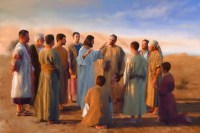
There weren’t many days left (about 18 months, by most estimates) before Jesus’ earthly ministry would end. It was time to choose the 12 ordinary unexceptional men who would carry the Gospel to the world.
Will there be Jews, or Muslims, or Hindus in heaven? Few questions are as thorny or as interesting. Adam Hamilton shares some thoughts on the subject.
 Spiritual Meditations