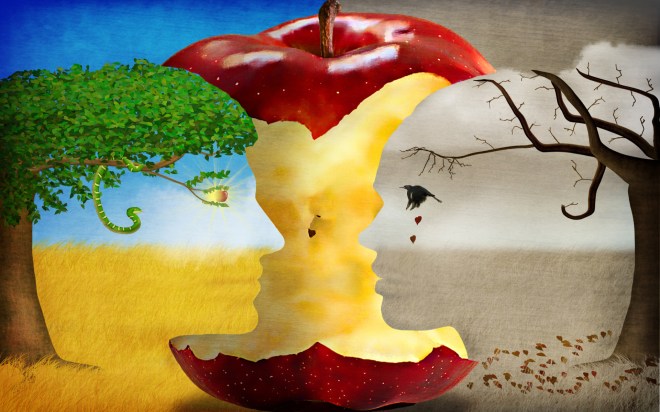
The rationalization of the doctrine of original sin teaches that the human soul is tainted. Sin, we are told, is embedded in our spiritual DNA. Human beings are flawed.
There is plenty of empirical evidence to support this point of view. From child abductions to child abuse, from street crimes to white-collar crimes, from terrorists to tyrants, from preemptive wars to heartless globalization, from politicians on the take to pornographers exploiting sex. It’s easy to argue that human beings are sinful and cursed.
The Source of Conventional Doctrine
Conventional doctrine teaches that Jesus took on all the sins of the world when he was crucified. We have been taught that Jesus had to die on the cross so that when we die, we will have eternal life. Jesus was the Lamb of God and the human sacrifice necessary to remove the blot of original sin on the human soul. However, in the Gospels, Jesus is never quoted as saying that he came to take away the sins of the world by death on the cross. Interestingly, it was other New Testament writers who interpreted the cross in this way and said that Jesus was the Lamb of God who came to take away the sins of the world.
Many scholars agree that this idea can be traced to the ancient practices of nomadic Hebrews who sacrificed animals to appease God.
There was also another ritual practiced by the ancient Hebrews. On the Day of Atonement, the High Priest would take a goat, symbolically cover it with the sins of all the people and send it out into the wilderness. Bearing everyone’s blame and being forced to suffer on everyone’s behalf, the innocent goat became a scapegoat.
Out of this theological perspective and cultural context, many New Testament writers then proclaimed the cross to be the definitive blood sacrifice. Jesus was like a pure and innocent lamb, a peace offering unto God. Jesus became our scapegoat, taking the consequences for our sins so that we wouldn’t have to take it on ourselves.
Add to this the prevailing notion at the time that God was separate, vengeful, and willing to forgive only when there was retribution, pain and the shedding of blood.
But Jesus never talks about his death being sacrificial. What mattered most to him was relationship—relationship with God, with family, with friends, with each other. In the four canonical gospels Jesus speaks seven times from the cross. One time he talks about being thirsty, another time he says, “it is finished.” His life and his ministry are fulfilled. The other five times have to do with his relationships.
What is Sin?
Many people are surprised to learn that the definition of sin in the New Testament has nothing to do with the inherent wickedness or corruption of the human species. Sin is translated to mean, “to miss the mark.” The word sin is etymologically linked to the word sunder, which means “to break apart.”
Rather than thinking of sin as a single event like the breaking of a rule, such as a traffic violation, it is more useful to see sin as a condition or state of being in which we see ourselves as literally separated from ourselves, others and the Divine.
We Sin Because We Don’t Know How to Love
In May of 1373, the Christian mystic Julian of Norwich received her revelations. During these she conversed at length with God on the topic of sin. She was told that we fall into sin not because we are wicked or corrupt, but because we are naive. There is no stain on the soul, we are merely ignorant. We sin, that is, we are estranged from others, because we don’t know any better.
Most importantly, Julian was shown that sin is not something for which we are handed punishment. The sense of separation and the feelings of alienation are themselves the consequences.
Every failure in relationship to God, every failure in relationship among and between us, is a result of being ignorant of the ways of love. When we don’t know how to live together it is because we don’t know how to love each other, or ourselves.
Every dastardly deed, every abusive action, every greedy, self-absorbed thought, word, and deed is a result of our ignorance. Whether it is a terrorist hijacking or a mundane insensitive oversight, it stems from the same thing: our ignorance as to how to love fully and utterly. There is no list of top 20 sins that God doles out appropriate punishment for. There is only the failure to love.
The more we drift from love, the more we miss the mark and punish ourselves. Love is giving without expecting to receive. Love allows kindness and compassion. In the absence of love we sin, we missed the mark. We act selfishly. We close our hearts.
Julian of Norwich asked God a question. She asked why, if He was all knowing, God didn’t know enough to prevent sin and suffering. God told her that sin is necessary. God also told her not to worry. That overtime, everything will work out. The world may appear to be in chaos now, but this disarray is necessary.
Every difficulty we experience is a teaching and reminder that there is only one consolation in life – our connection with God. The purpose of sin is not to create guilt or attract punishment but to remind us of how to live our lives close to each other and the Holy One, and to teach us how to love.
Love is not just a feeling, love is not just an emotion; It is the awareness that we are all a part of each other, we are always connected.
Conclusion
This is what Jesus meant when he said the greatest commandment is to love God and everyone —God in me, God in you, you in me, me in you, God in all of us. Empathy, seeing you in me and me in you, is the heart of compassion. Because compassion heals separation, compassion lessens everyone’s suffering.
When we know this, we lighten and open up. When we open up, we become more spacious. There’s room in us for others. When we open up, we can see you in me, me in you. And when we see this, we realize that whatever separation we experience with others is created in our own minds.
Additional discussion of the Garden of Eden story and the revelations of Julian of Norwich can be found in:
There’s More in the Garden of Eden
If you found this post interesting, inspiring, informative, or useful, please follow us and share. Many more posts to feed your soul can be found on the Navigation Menu. God bless you.
Relevant Scripture
Jesus replied: “‘Love the Lord your God with all your heart and with all your soul and with all your mind. This is the first and greatest commandment. And the second is like it: ‘Love your neighbor as yourself. All the Law and the Prophets hang on these two commandments.” (Matthew 22:37-40)
So in everything, do to others what you would have them do to you, for this sums up the Law and the Prophets. (Matthew 7:12)
No one who is born of God will continue to sin, because God’s seed remains in them; they cannot go on sinning, because they have been born of God. This is how we know who the children of God are and who the children of the devil are: Anyone who does not do what is right is not God’s child, nor is anyone who does not love their brother and sister. (1 John 3:9-10)
Reference
A Voluptuous God by Robert V. Thompson
 Spiritual Meditations